We Care About Your Privacy
By clicking “Accept all”, you agree to the storing of cookies on your device to enhance site navigation, analyze site usage, and assist in our marketing efforts. View our Privacy Policy.

For multilingual learners, the process of learning English alongside learning about curriculum concepts in different subjects is often a complex and demanding one. Many EAL learners may compare themselves with fluent peers, which may cause anxiety or negative feelings towards learning and thus inhibit or delay the language acquisition process (Suleimenova, 2013). Read more on this in our article EAL barriers to learning and wellbeing.
Could the use of more mindful and reflective approaches to learning be the answer to this and, if yes, can multilingual families adopt such techniques to help build more confident language learners? This article will explore the recent literature in this area and suggest practical ways for families to support multilingual children in learning English more mindfully.
Research shows that both mindfulness and reflective thinking are significant components of 21st-century education. Mindfulness is about bringing attention to the immediate environment around us. Mindfulness breathing exercises help to enhance memory and concentration, whilst reducing stress and wandering of the mind (Tasan et al., 2021). Several studies found positive effects of mindfulness on learner attention, levels of language anxiety, and test results (Mortimore, 2017). Zeilhofer & Sasao (2022) investigated the relationship between mindfulness and vocabulary development and they found that mindfulness techniques not only help to improve general academic performance but also facilitate vocabulary learning.
We also know that reflecting on learning involves critical thinking that allows learners to evaluate and better understand what happened during learning (Chamdani et al., 2022). Therefore, promoting self-evaluation practices and frequent reflection on current learning or next steps gives learners a sense of ownership and more positive feelings about their learning.
Parents can explicitly draw attention to a child’s progress and growth over time in many different ways. Simple strategies include keeping a record of their child’s writing and using ‘then and now’ comparisons when revisiting earlier writing samples or recording their answers to short speaking questions at different points in the year. These activities can offer valuable opportunities for reflection and conversations on how their children’s speaking skills and confidence have developed over time. In turn, this will help multilingual learners recognise their own improvements and view their language learning journey as a positive experience of growth.
Parents can also create opportunities to pause and reflect on learning at home with useful prompt questions addressed to their children, such as:
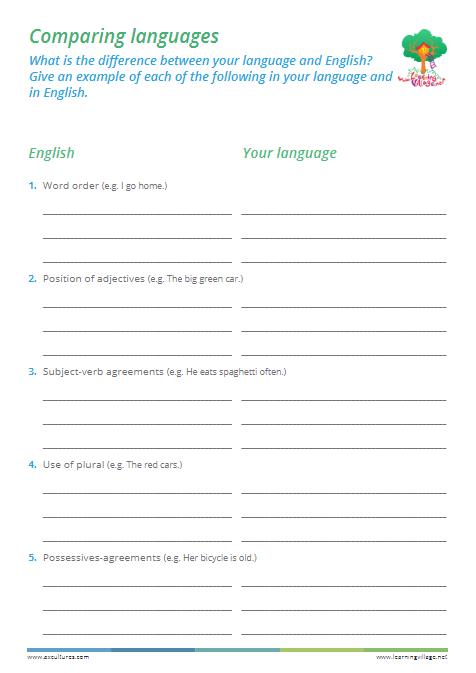
These questions encourage learners to think about learning as a process they can actively control and improve. For more ideas on reflection questions and similar family learning activities, click on the buttons at the top and bottom of this page to download our resource Mindful and reflective language learning techniques - A guide for parents and multilingual families.
Visual tools, such as reflection cards, vocabulary logs, and goal-setting sheets can also support reflection for multilingual learners. Click here (members only) to view an example of Learner reflection labels used in the Learning Village. Also, click here (members only) to view The Remember Book, a useful record of the new vocabulary that learners have acquired at the end of every lesson in order to support revision of English outside the classroom. Finally, download our Co-regulation and self-regulation strategies sheet and explore ways to help children regulate their emotions and develop feelings of calmness.
A more mindful and reflective approach to learning helps multilingual learners move from passively participating in lessons to actively engaging in their learning and setting the foundations for increased confidence and more positive learning experiences.
References
Chamdani, M., Yusuf, F. A., Salimi, M., & Fajari, L. E. W. (2022). Meta-analysis study: The relationship between reflective thinking and learning achievement. Journal on Efficiency and Responsibility in Education and Science 15(3): 181–188. (Accessed online here).
Mortimore, L. (2017). Mindfulness and foreign language anxiety in the bilingual primary classroom. Educación y Futuro 37(1): 15–43.
Suleimenova, Z. (2013). Speaking anxiety in a foreign language classroom in Kazakhstan. Procedia - Social and Behavioural Sciences. 93: 1860–1868. (Accessed online here).
Tasan, M., Mede, E., & Sadeghi, K. (2021). The effect of pranayama breathing as a positive psychology exercise on foreign language learning anxiety and test anxiety among language learners at tertiary level. Frontiers in Psychology 12, 60–73. (Accessed online here).
Zeilhofer, L., & Sasao, Y. (2022). Mindful language learning: The effects of college students’ mindfulness on short-term vocabulary retention. System 110: 102909 (Accessed online here).
Stories are a powerful way for children to develop language skills and connect with their culture. Specifically, for EAL families, storytelling in their home language is a way to preserve cultural traditions and is an essential part of their children’s multilingual development.
AI technology can offer adult learners of English or multilingual families a supportive, fun and engaging environment in which to learn and practise their English. Schools can play an instrumental role in guiding those families through this process and therefore home-school collaboration is always encouraged. Let’s look at four different ideas for school staff to encourage their multilingual families to engage in an enjoyable language learning experience through AI.
Home is the first learning environment for children and particularly for children who learn through EAL, home can be a powerful learning environment filled with opportunities for language development. Multilingual families often wonder how they can help their children improve English at home or maintain their home language(s) and the answer to this is: use resources that you already have around you.



A lovely resource which encourages your learners to explore an interesting image and create and discuss their own.


Blended vocabulary, language structure and reading programme for EAL and multilingual learners
Once you have registered for your free trial we will be in touch to get you started on the first step of your Learning Village Journey.