We Care About Your Privacy
By clicking “Accept all”, you agree to the storing of cookies on your device to enhance site navigation, analyze site usage, and assist in our marketing efforts. View our Privacy Policy.
The choice of appropriate materials for language learning can shape the learning experience, promote motivation and facilitate the learning process (Gilmore, 2007). EAL teachers evaluate their options and often wonder about the benefits of coursebooks compared to authentic, real-life texts and media content for their learners. This article suggests that the combination of textbooks and authentic materials is the way forward, not only for EAL teachers in class, but also for multilingual families who seek to support their children with language learning at home.
Coursebooks can be used either as the main teaching resource in the classroom or as supplementary material to existing resources. They are designed by experienced teachers, offer structure in class, and provide a framework for lessons based on a pre-defined syllabus (Tok, 2010). While coursebooks offer a structured approach to learning, the significance of using authentic materials in class, such as storybooks, cartoons, menus, or podcasts, can bring language to life in ways that are engaging and deeply motivating.
Although authentic materials, such as songs, videos, podcasts, bedtime stories, or newspaper articles are not originally created for pedagogical purposes, they link real-life communication with language learning (Gilmore, 2007). Choosing age-appropriate authentic materials for language learning enhances learner motivation and helps expose learners to everyday idiomatic language with cultural references (Bacon & Finnemann, 1990). Understanding real-life content can be challenging for language learners, but we ultimately want learners to be able to comprehend texts created and encountered by native speakers in real life (Ur, 1996).
Parents should look for age-appropriate authentic materials for learning but they should also consider their children’s interests in the process of choosing materials. Children are more likely to engage with real-life content that is based on their interests, whether it is their favourite cartoon, a comic book, or a cooking video, as the link with their personal interests creates an emotional connection that makes learning more enjoyable and effective (Gilmore, 2007). Moreover, authentic materials often combine visuals, audio, and text and support multimodal learning, as they involve learning through multiple senses (The New London Group, 1996). This is especially helpful for learners with short attention spans, such as younger learners or those with different learning styles. Find out more about multimodal learning and learning through images in our article ‘Beyond words - the power of images for EAL learners’ here.
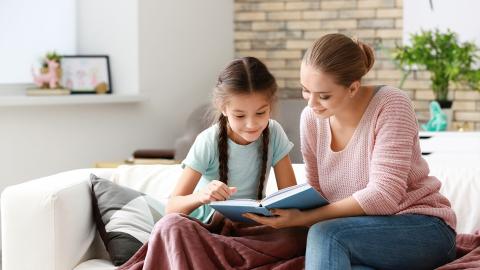
The key to striking a balance in supporting a child’s language learning at home is to use authentic materials that match the child’s interests and language level. Engaging with authentic language content regularly can be an opportunity for language practice, creativity, and immersion that reinforces what they are learning in class and can help build their confidence. For more ideas on how to support a child’s language development at home, read our article ‘EAL families: the power of reading stories in home languages’ here.
Download our resource ‘Using authentic materials to support language learning at home - Tips for parents’ using the buttons at the top and bottom of this article, and help multilingual families enrich their repertoire of home activities to support learning through authentic materials.
References
Bacon, S. M., & Finneman, M. D. (1990). A study of the attitudes, motives, and strategies of university foreign language students and their disposition to authentic oral and written input. The Modern Language Journal 74(4): 459-473.
Gilmore, A. (2007). Authentic materials and authenticity in foreign language learning. Language Teaching 40(2): 97-118.
The New London Group (1996). A pedagogy of multiliteracies: designing social futures. Harvard Educational Review 66(1): 60-92. Accessed online here.
Tok, H. (2010). TEFL textbook evaluation: from teachers’ perspectives. Educational Research and Review 5(9): 508-517. Accessed online here.
Ur, P. (1996). A course in language teaching: Practice and theory. Cambridge: Cambridge University Press.
For multilingual learners, the process of learning English alongside learning about curriculum concepts in different subjects is often a complex and demanding one. Many EAL learners may compare themselves with fluent peers, which may cause anxiety or negative feelings towards learning and thus inhibit or delay the language acquisition process (Suleimenova, 2013). Read more on this in our article EAL barriers to learning and wellbeing.
You may be able to recall a lesson where learners were fully engaged and motivated. These teaching experiences are deeply rewarding for educators and essentially one of the reasons why we enjoy our jobs as teachers. However, realistically, teachers often face the reality of being unable to reach some students until they present lesson input slightly differently.
Language is a key part of one’s identity and our level of fluency in a language can truly affect the way we view ourselves (Patterson, 2021). It is often incredibly difficult for monolingual individuals, who are highly proficient in their language, to imagine the extent to which language ability in any language, be it a home language or an additional language, is linked to one’s self confidence and perception of themselves. What happens when your level of language proficiency becomes a barrier to communication, learning, and the world around you?


Blended vocabulary, language structure and reading programme for EAL and multilingual learners
Once you have registered for your free trial we will be in touch to get you started on the first step of your Learning Village Journey.