We Care About Your Privacy
By clicking “Accept all”, you agree to the storing of cookies on your device to enhance site navigation, analyze site usage, and assist in our marketing efforts. View our Privacy Policy.



In ESOL classrooms, we often find that language is both the medium and the barrier. ESOL learners may understand ideas, routines, and concepts long before they can express them confidently in English. However, when teaching relies too heavily on spoken or written language, many learners can feel excluded from full participation and this can turn into a challenge. This is where images play a crucial role. Used intentionally, visuals reduce cognitive load, support comprehension, and provide learners with meaningful messages in English.
The greatest impact when using images in ESOL teaching comes when visuals are embedded systematically into lesson planning and aligned with clear language outcomes.
Visuals allow ESOL learners to access meaning before language. For many ESOL learners, particularly at Entry Levels, understanding develops faster than spoken or written output, and images help bridge this gap.
For example, in an Entry Level 1 class working on daily routines, a teacher might begin with images of waking up, travelling to work, and cooking dinner. Learners point, act out, or use single words to show understanding before any written language is introduced. Only once meaning is secure does the teacher introduce the English phrases. This ensures learners are not simply decoding language but they attach meaning to the images.
According to Mayer’s research, “people learn better from words and pictures than from words alone” (Mayer, 2009), because images provide immediate access to meaning and it allows learners to engage from the start.
With online ESOL programmes like Community Village, learners can explore real and concrete visuals before seeing the text. Learners can click on the images to hear key vocabulary or language structures translated into their home language.
ESOL learners often juggle new vocabulary, grammar, pronunciation, and context simultaneously. This can result in cognitive overload. Visuals reduce this load by anchoring meaning and clarifying context.
For example, in a lesson on visiting the doctor, ESOL learners may struggle with exchanging phrases and taking turns in the dialogue. But when the teacher adds a simple visual sequence like a waiting room, a doctor, a nurse, and a prescription, the learners are then able to visualise the situation first. Later, when they read the dialogue, phrases such as What’s the problem? and What is wrong with you? become easier to process because the context has already been made clear through images.
Dual Coding Theory explains that “information encoded in both imagery and verbal systems has a greater chance of being retrieved” (Paivio, 1986) and, therefore, visuals support memory as well as comprehension and they aid listening.
Images are most effective when they are reused purposefully across activities. Vocabulary learning improves when ESOL learners meet words repeatedly in varied contexts.
In a food and shopping lesson, a teacher might introduce vocabulary using real supermarket images. In the next lesson, the same images can be reused to practise countable and uncountable nouns in a role-play in a shop, or support sentence writing (I like… /I don’t like…). The visuals remain constant while the language demand increases.
Speaking is often the language skill that ESOL learners find most intimidating. Images give learners something concrete to talk about.
In a mixed-level class, a single busy street image can support differentiation naturally. Some learners name objects (Bus, Shop), others describe actions (People are crossing the road), while more confident learners discuss issues (It’s dangerous because…). Everyone participates using the same visual prompt.
Krashen reminds us that “low anxiety and high motivation are essential for language acquisition” (Krashen, 1982) and, naturally, images reduce pressure and promote meaningful talk.
Writing places high linguistic and cognitive demands on ESOL learners. Visuals provide ideas and opportunities for oral practice before the learner starts writing.
Before writing an email about missing an appointment due to sickness, learners might have three images, e.g. a calendar, a sick person, and a phone. This preparation leads to clearer and more structured writing at a later stage.
When visuals reflect learners’ cultures, experiences, and aspirations, they validate their identity and encourage engagement.
In a lesson on jobs, ESOL learners can choose images that reflect their own work experiences.They may speak more confidently when describing a familiar job from their home country, e.g. an influencer versus a farmer. As Cummins argues, “instructional strategies that acknowledge and build on students’ linguistic and cultural resources are more likely to result in academic success” (Cummins, 2001).
Images are not an optional extra in ESOL teaching. The key question ESOL teachers should always be asking is: What language does this image help the learner understand or use?. Visuals support comprehension, reduce cognitive load, and promote communication. They can make language visible and learning accessible.
Beyond words, images give ESOL learners confidence, clarity, and a way forward in the learning process.
References
Cummins, J. (2001) Negotiating Identities: Education for Empowerment in a Diverse Society. 2nd edn. Los Angeles: California Association for Bilingual Education.
Krashen, S. (1982) Principles and Practice in Second Language Acquisition. Oxford: Pergamon.
Mayer, R.E. (2009) Multimedia Learning. 2nd edn. Cambridge: Cambridge University Press.
Paivio, A. (1986) Mental Representations: A Dual Coding Approach. Oxford: Oxford University Press.
In today’s multilingual classrooms, teachers are constantly balancing between helping learners access the curriculum content whilst supporting the development of their English language skills. For those of us who teach EAL learners, the question isn’t what to teach, but how to make the curriculum accessible without diluting its richness and simplifying it too much.
Beckmann (2009) defines the term ‘cross-curricular teaching’ as ‘instruction within a field in which subject boundaries are crossed and other subjects are integrated into the teaching (how and for whatever purpose or objective)’.
Similarly, see here for guidance on CLIL (content and language integrated learning) teaching.
Attending a recent woodwind ensemble concert made me think about language use in the classroom - quite an unusual connection, right? ‘How so?’ you might ask. Perhaps it was because the musicians each had a different heritage, played a different instrument, and spoke another language. Yet, they all tuned their instruments together at the start and communicated in English before creating something beautifully fluid for the audience to immerse themselves in.


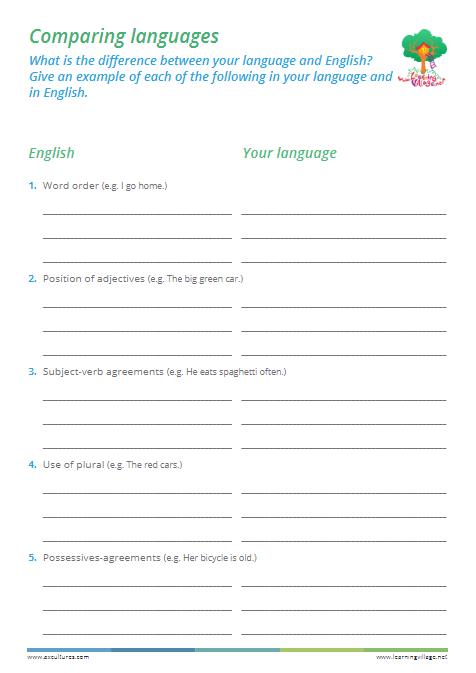

A lovely resource which encourages your learners to explore an interesting image and create and discuss their own.


Blended vocabulary, language structure and reading programme for EAL and multilingual learners
Once you have registered for your free trial we will be in touch to get you started on the first step of your Learning Village Journey.