We Care About Your Privacy
By clicking “Accept all”, you agree to the storing of cookies on your device to enhance site navigation, analyze site usage, and assist in our marketing efforts. View our Privacy Policy.
"Sawasdee krub!”
“nǐ hǎo!”
“Hello!”
“Annyeonghaseyo!”
As a leader of an international school setting over the last decade, my fluency in saying ‘hello’ in multiple languages has only improved! Taking advice and guidance from families and the community has made a huge difference in creating an important sense of belonging, not only for the children but the parents, too.
Often when a child joins us in Pre-nursery speaking their home languages, the first concern of the caregiver is ‘Will they be okay if they don’t speak English?’. Confidently, the answer is always ‘yes’. However, how we create the confidence for that ‘yes’ is a multi-modal approach that begins from the point of admission to the school.
Whichever language children speak, it’s essential that we honour and respect their home language.
During our initial conversations with families, we talk about the importance of a strong home language as the base for conceptual understanding. If the caregivers all speak multiple languages fluently, we advise one adult for one language, thus allowing young children to ‘code switch’. If nobody in the family speaks English, that is fine, too - with high-quality, direct instruction you can reasonably expect a neurotypical child to learn a second language rapidly.
Within our setting, we use Makaton as a bridge for functional language such as ‘toilet’, ‘hungry’, ‘thirsty’, and ‘help’, partnering with families to teach the language both in the child’s home language and in English, so that those very immediate needs are able to be met. From a place of security and safety, language will blossom.
It is important to note that in my experience, trilingual learners can often take much longer to develop confidence in their concepts and application of them verbally - this can frequently lead to a mislabelling of the child as a reluctant speaker. Often, it is simply time that is needed.
Parents and older students are also invited into the setting to play in a child’s home language and also share stories.. We have had several opportunities for families to share their own cultural heritage, through stories, songs, and even making food with the children. In this way, representation adds to a sense of belonging.
Teacher: "We're going to plant the seed. A seed — เมล็ด."
Child: "เมล็ด."
Teacher: "Yes! A seed. What do we put the seed in?"
Child: "ดิน."
Teacher: "Yes, soil. We put the seed in the soil."
Confident translanguaging opportunities exist within Early Years settings, particularly when employing bilingual staff.
A targeted approach to language learning is therefore essential, with training and support for all staff to understand how to develop a primary and secondary language without subtraction. The key to this is honouring the home language - for example: A child is playing outside, and asks for help in their home language. The bilingual staff member listens, understands, and responds in the second language, often using targeted Makaton language as support. This is, of course, if you have the language levels available to you. However, a strong community will yield surprising results; we have the benefit of being an all-through setting, and will regularly ask for Senior School volunteers to play with children in their home language if we cannot meet the need among the staffing body!
Where the difference is often most visible, it is also most useful. Take, for example, our morning routines - the children enter the setting and are expected to remove shoes, put away their bags, tidy away their water bottles, and then enter their play, all with a level of independence that increases depending on their age. These steps are supported by visuals both in the home language and Makaton as a bridge, placed helpfully close to the entrance of the classroom, visible for the adults supporting the independence as well as the children following the steps.
The environment also reflects children’s identities, with family photos and children’s nationalities represented through familiar items such as flags or items from that child’s home country. In this way, children’s representation of their own identities helps to guide their sense of belonging.
When children can hear and see their home language represented and valued, they will often feel more confident to practise a second language with those around them. Among the most surprising elements of our approach to language development at King’s College is seeing how English vocabulary blossoms alongside a home language, particularly from the end of Nursery through to Reception.
Raj Ladva is the Head of Early Years and a senior leader at King’s College International School Bangkok, an all-through setting for 2-18-year-olds.. The Early Years Centre at King’s College comprises approximately 300 children aged 2-5 years, across 18 classes in a purpose-built setting in the heart of Bangkok. Ladva has recently co-authored a book titled ‘Bottling Joy in the Early Years’ (also available as an ebook), giving insight into the college’s approach to Early Years education in Thailand, honouring the local culture and meaningfully incorporating children’s lived experiences into their daily learning.
Translanguaging as a Bilingual Education Pedagogy in Early Childhood Education: A Systematic Review
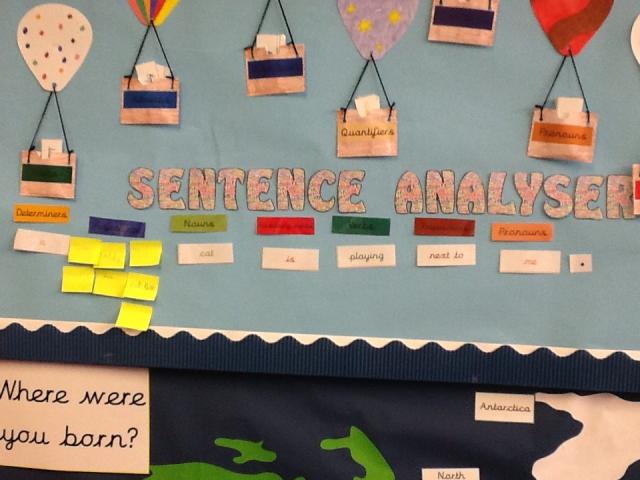
Lea Forest, my school in Birmingham, has been using the Learning Village for over three years. It has proved a highly effective learning and teaching resource, with the children making strong progress. The Learning Village asked us to pilot its newest feature: the Sentence Analyser!
We were seeking a resource that would help us teach the average 75,000 words needed for the children’s language to flourish and to deepen their morphology skills. We thought the Sentence Analyser may be a useful resource.
For some learners, including those with SEND, the thought of a writing lesson can be daunting and unappealing. However, by finding creative ways to engage and 'hook' your learners, they will be more likely to feel motivated and engaged.
Tip or Idea: Start your lessons in an unusual or exciting way! Set up a scene or have props that give clues to a character or event, play an engaging video or audio clip or perhaps transform your classroom into a courtroom for a debate...
English for Speakers of Other Languages (ESOL) programmes play an important role in helping migrants, refugees, and multilingual communities participate fully in society. Proficiency in English allows adults to access employment, education, healthcare, and community life. However, many adults who would benefit from ESOL are still unable to access it.


Blended vocabulary, language structure and reading programme for EAL and multilingual learners
Once you have registered for your free trial we will be in touch to get you started on the first step of your Learning Village Journey.