We Care About Your Privacy
By clicking “Accept all”, you agree to the storing of cookies on your device to enhance site navigation, analyze site usage, and assist in our marketing efforts. View our Privacy Policy.
Language is a key part of one’s identity and our level of fluency in a language can truly affect the way we view ourselves (Patterson, 2021). It is often incredibly difficult for monolingual individuals, who are highly proficient in their language, to imagine the extent to which language ability in any language, be it a home language or an additional language, is linked to one’s self confidence and perception of themselves. What happens when your level of language proficiency becomes a barrier to communication, learning, and the world around you? Can the linguistic challenges that beginner-level EAL learners are faced with in the English classroom have an impact on their overall wellbeing?
The answer, unfortunately, is yes. EAL children, especially when they are new to an English-speaking school, may be facing a number of challenges, including entering an unfamiliar school environment, not having adequate linguistic devices to access communication around them or the school curriculum, experiencing culture shock, and isolation. Limited language will inevitably affect their academic performance, as language proficiency is linked to academic success (Hessel & Strand, 2021).
However, it is not only their capacity to access learning and excel at school that will be affected. Looking at the emotional aspects of language learning, this situation will also affect their emotional state and ultimately their wellbeing. According to a study on supporting the social and emotional needs of migrant children, feelings of anxiety are quite common and related to establishing positive relationships with peers and teachers (Hamilton, 2012). Young people who cannot fully express themselves in English may struggle to advocate for themselves or participate confidently in class discussions. This may be accompanied by a sense of isolation and shame associated with a perceived lack of language competence on their part.
A descriptive case study focusing on bilingual pre-schoolers’ socio-emotional experiences while learning through EAL showed that children often displayed apprehension over talking in English, and froze or looked away when adults spoke English to them (Farndale, A. et.al, 2016). Finally, research has highlighted emotional challenges for EAL children when separated from their parents (Farndale, A. et.al, 2016; Bligh, 2014).
In my own experience of teaching Greek-English bilingual children, I observed that when a bilingual child switches to their strong language, they exhibit elements of their personality very differently and much more confidently. Previous pauses and hesitations in their speech when they were using their weak language give way to uninterrupted flow of natural-sounding speech, sustained communication on different topics, and active involvement in jokes. This experience left me thinking that, for bilingual people, having two languages is almost like having two identities, determined largely by their feelings of confidence while using each language.
So, what can teachers do to help EAL learners gradually develop their confidence in English? The answer is to focus on: empathy, inclusion, and building trust. Research shows that empathetic and inclusive educational practices are absolutely essential, not only for EAL learners’ academic performance, but also for their wellbeing. A teacher’s goal should be to understand an EAL child’s community and culture as well as their social and emotional experience in school. The more a teacher acknowledges and seeks to learn about a bilingual learner's heritage, the more likely it is for the child to experience a successful school life. In line with the recent Ofsted framework for multilingual learners, teachers and leaders should recognise that EAL children already speak at least one language and should not lower their expectations of them (DfE, 2025). For more information on the new Ofsted framework and expectations, read our article here.
Inclusive educational practices encourage a sense of belonging for multilingual learners and enhance their emotional stability. Practices, such as translanguaging, Content and Language Integrated Learning (CLIL), and celebration of cultural diversity create educational environments that recognise multilingualism as a resource in the classroom. These practices create lessons that allow learners to draw on their first language while learning English. Read our article on using CLIL across cultures here to find out more about this approach to learning and other inclusive practices. Also, find out more about translanguaging in teaching here. When EAL learners see their languages and cultural identities reflected in the classroom environment and their lessons, they know that they belong and that key parts of their identities are valued. Contrary to that, to suggest that a child’s home language is not useful for them at school is like disregarding an integral part of a child’s identity (Patterson, 2021).
Considering children’s emotional wellbeing is a fundamental part of our effort to create an optimal state for learning for them. Helping EAL learners to develop feelings of trust in their language ability or trust towards school staff, through actively showing acceptance of their ‘differences’, will support them with the challenges they may be facing in their language learning journey. Specifically, planning for home language use in their homework, or interactions with peers or staff who speak their home language, may reduce feelings of anxiety for bilingual learners significantly, particularly if children display signs of insecurity when speaking English. Finally, watching out for signs that children’s emotional wellbeing may suffer is key. These signs may include:
Click on our downloadable resource to find useful ideas and strategies on how to best support EAL children with emotional regulation.
References
Bligh, C. (2014). The Silent experiences of young bilingual learners: A sociocultural study into the silent period. Rotterdam: Sense Publishers.
Department for Education. (2025). State-funded school inspection toolkit. Updated 9 September 2025. Available here (Accessed: November 2025).
Farndale, A., Harris P., & De Courcy, M. (2016) Social, emotional and linguistic experiences of developing bilingual preschoolers as they learn English as an Additional Language (EAL). The International Journal of Learning, 23: 41-58.
Hamilton, P. L. (2012). It’s not all about academic achievement: supporting the social and emotional needs of migrant worker children. Pastoral Care in Education, 31(2): 173–190.
Hessel, A. K., & Strand, S. (2021). Proficiency in English is a better predictor of educational achievement than English as an Additional Language (EAL). Educational Review, 75(4), 763–786.
Patterson, K. (2021). Using home language as a resource in the classroom: A Guide for teachers of English learners. Alexandria: TESOL International Association.
AI technology can offer adult learners of English or multilingual families a supportive, fun and engaging environment in which to learn and practise their English. Schools can play an instrumental role in guiding those families through this process and therefore home-school collaboration is always encouraged. Let’s look at four different ideas for school staff to encourage their multilingual families to engage in an enjoyable language learning experience through AI.
Assessment is a natural and integral part of effective teaching, with teachers continually assessing learner progress and identifying next steps for teaching and learning (DfE, 2020). Teachers assess learners for multiple reasons but one of the most pressing tasks for teachers is to assess their newly-arrived EAL learners’ level of English proficiency.
As teachers, we recognise that meaningful home-school communication is essential for establishing school practices and instilling positive life values that will guide our learners throughout their lives.


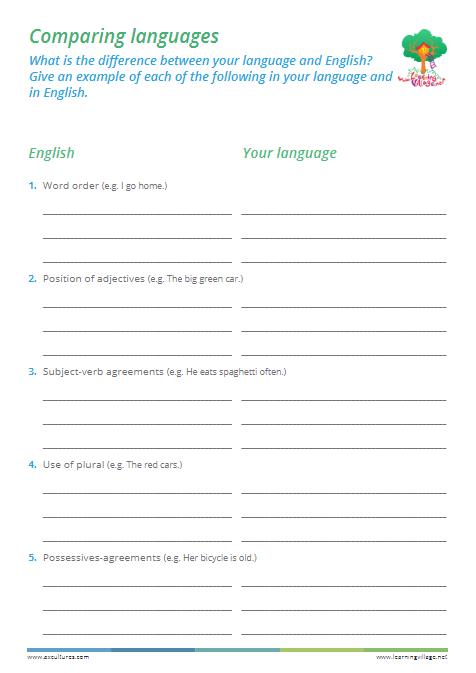

A lovely resource which encourages your learners to explore an interesting image and create and discuss their own.


Blended vocabulary, language structure and reading programme for EAL and multilingual learners
Once you have registered for your free trial we will be in touch to get you started on the first step of your Learning Village Journey.