We Care About Your Privacy
By clicking “Accept all”, you agree to the storing of cookies on your device to enhance site navigation, analyze site usage, and assist in our marketing efforts. View our Privacy Policy.



Remote Aboriginal and Torres Strait Islander communities in Australia face educational challenges shaped by historical, cultural, and geographical factors. Historical legacy has disrupted trust in schools for many families and these experiences may influence children’s engagement with education.
If young people are unable to see how education relates to life beyond their community, motivation and engagement decline. Gower, Ferguson, and Forrest (2021) argue that strong school/community partnerships are critical in addressing these issues, as trust and collaboration are foundational to improving student engagement and outcomes.
The Australian Government Department of Education (2025) emphasises the importance of enabling all learners to reach their full potential. Recognising that family and community involvement plays a central role in student success is vital in engaging communities in the learning journeys of young people.
In Australia, proficiency in Standard Australian English (SAE) is widely viewed as fundamental to academic success and curriculum access (Australian Department of Education, Capability Framework, 2013). Schools should adopt an EAL/D (English as an Additional Language or Dialect) approach that recognises learners’ existing linguistic knowledge while supporting their acquisition of English.
A comprehensive EAL/D program is essential to ensure equitable access to curriculum. Such programs should ideally be inclusive of students with low literacy levels and those with Special Educational Needs (SEN), ensuring support for all learners.
School actions to support learners include:
Steele and Wigglesworth (2023) note that some educators may not recognise speakers of non-standard English dialects as EAL/D learners, as they present as English speaking, resulting in insufficient or inappropriate language support. This non-recognition can disadvantage learners who need proficiency in English to access further education and employment opportunities (Australian Government Department of Education 2025).
Efforts to promote English have often relied on top-down approaches that position it as superior to home languages. This can undermine students’ cultural identity and contribute to disengagement. Lowe et al. (2021) argue that authentic inclusion of Indigenous language and culture is essential for effective learning in Indigenous contexts. English can be reframed as an additional tool for participation in wider Australian society rather than as a corrective measure. This strengthens relationships between schools and communities and supports sustained engagement.
School actions to support families and communities include:
When EAL/D programs are delivered through blended or digital platforms, they create opportunities for parents and caregivers to participate alongside their children. Platforms that include adult ESOL encourage shared learning experiences and help families better understand the curriculum. Side-by-side learning models foster positive learning interactions within families and support language development across generations. This can contribute to improved educational outcomes, increased confidence, and broader access to learning and employment pathways.
School actions to strengthen engagement include:
A significant challenge in remote Indigenous contexts is the limited availability of EAL/D specialist teachers. Even when educators recognise the need to teach English as an additional language or dialect, they may lack the training, time, or confidence to do so effectively. This can lead to teacher stress and inconsistent instructional practices.
A whole-school EAL/D strategy addresses this by providing all staff with access to scaffolded resources and targeted professional learning. When teachers are equipped with practical tools and clear guidance, they can support learners’ language development and curriculum access.
School actions to support teachers include:
References:
Australian Government Department of Education. (2025). Closing the Gap. Available here.
Gower, G., Ferguson, C., & Forrest, S. (2021). Building effective school–community partnerships in Aboriginal remote school settings. The Australian Journal of Indigenous Education, 50, 359–367. Available here.
Lowe, K., Skrebneva, I., Burgess, C., Harrison, N., & Vass, G. (2021). Towards an Australian model of culturally nourishing schooling. Journal of Curriculum Studies, 53(4), 467–481. Available here.
Queensland Department of Education, Training and Employment. (2013). Capability Framework: Teaching Aboriginal and Torres Strait Islander EAL/D learners (PDF). Available here.
Steele, C., & Wigglesworth, G. (2023). Recognising the SAE language learning needs of Indigenous primary school students who speak contact languages. Language and Education, 37(3), 346–363. Available here.


You might be an experienced teacher, new to teaching, or support staff, but you have never taught any EAL learners before. You are in for an exciting journey! You may initially feel overwhelmed and frustrated by the barriers to communication with your new learners, but you will soon find that your lessons have potential to be creative, interactive and a heap of fun!
I will never forget the ‘feelings’ I experienced during my EAL teacher training, when I sat in a class with a tutor who entered the room with a basket of goodies and greeted us in Swedish. My immediate reaction was one of confusion, which then led to frustration and finally a sense of hopelessness, before I even realised that I was actually expected to experience learning some Swedish without a single word of English allowed in the classroom.
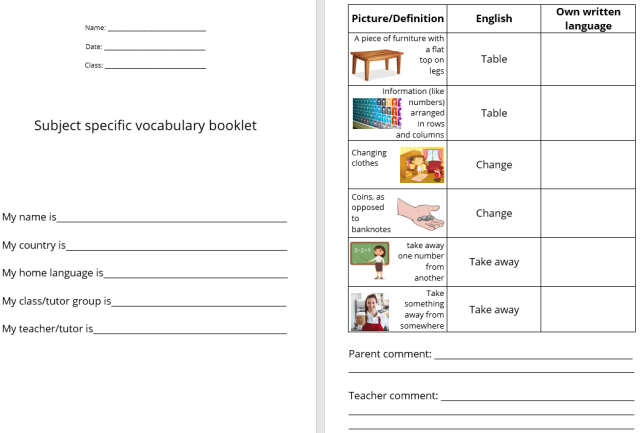
Maths is often a subject that is not given the same priority as others when it comes to the teaching of learners with English as an additional language (EAL). You may have heard the statement that maths is a universal language: there is often an expectation that EAL learners will be able to access the subject in the same way as their monolingual peers, without being given any additional consideration.