We Care About Your Privacy
By clicking “Accept all”, you agree to the storing of cookies on your device to enhance site navigation, analyze site usage, and assist in our marketing efforts. View our Privacy Policy.
English for Speakers of Other Languages (ESOL) programmes play an important role in helping migrants, refugees, and multilingual communities participate fully in society. Proficiency in English allows adults to access employment, education, healthcare, and community life. However, many adults who would benefit from ESOL are still unable to access it.
Across the UK, research consistently highlights a range of structural, economic, and social barriers that prevent participation in ESOL programmes. A House of Lords report (2018) notes, ‘there are significant barriers to accessing ESOL provision, including cost, availability of classes, lack of childcare and the difficulty of fitting lessons around work’.
Understanding these barriers is essential if policymakers, providers, and educators want to design effective and inclusive ESOL provision.
In many areas of the UK, there is a mismatch between demand for ESOL and the availability of courses, where waiting lists are common and ESOL providers struggle to meet local demand due to limited funding and staffing.
Research commissioned by the UK government highlights the scale of this issue: ‘Demand for English for Speakers of Other Languages (ESOL) provision has been documented as being greater than supply.’ (Department for Business, Innovation and Skills, 2016).
Limited course availability can result in long waiting lists or restricted entry criteria. Funding structures can also prevent access, particularly when learners are required to pay course fees or when eligibility rules exclude certain immigration categories.
In addition, many ESOL programmes operate within rigid timetables and classroom structures that do not always align with the everyday lives of adult learners.
Work commitments are one of the most significant barriers preventing adults from attending ESOL classes. Many migrants are employed in sectors such as hospitality or social care, where shifts are irregular and unpredictable. Research into ESOL access for people in employment highlights how work schedules frequently conflict with course times: ‘Many learners reported being unable to attend ESOL classes due to their working patterns’ (The Bell Foundation, 2022).
For learners working multiple jobs or on zero-hours contracts, attending a weekly class may be impossible. Missing work often means losing much needed income, making education a difficult priority despite strong motivation to improve English.
Childcare responsibilities represent another major barrier, particularly for women. Many migrant mothers want to improve their English but cannot attend classes because they have no-one to care for their children.
This barrier has been widely documented in policy discussions on ESOL access. A UK parliamentary inquiry into integration found: ‘One of the main barriers to accessing ESOL classes is the difficulty of finding childcare’ (House of Lords, 2018, The Integration of Refugees).
Without access to affordable childcare or crèche facilities, parents may be unable to attend classes regularly. This can contribute to long-term language isolation and reduced opportunities for employment or social participation.
Some ESOL programmes are successfully offering classes where parents bring their children or by providing on-site childcare during lessons.
Health and wellbeing can also significantly affect access to ESOL. Many migrants and refugees have experienced trauma, displacement, or long periods of uncertainty related to their immigration status.
Research exploring ESOL participation in London found that health issues were a key barrier for many learners: ‘Health was identified as the biggest barrier to accessing ESOL provision’ (Waltham Forest Council, 2023, Left Out, Left Behind: Barriers to ESOL Access).
Physical health issues can make travel difficult, particularly when classes are located far from home. Mental health challenges such as anxiety, trauma, or lack of confidence may also discourage learners from participating in classroom settings.
Another common barrier is simply not knowing how to access ESOL provision. Many migrants are unfamiliar with the UK education system and may not know where to find courses or how to enrol.
Information about ESOL classes is often available only in English, which creates an obvious barrier for individuals who most need language support. In addition, referral pathways between community organisations, local authorities, and education providers might not always be well coordinated. As a result, many potential learners remain unaware of opportunities that already exist in their communities.
Community outreach and multilingual information campaigns can significantly improve participation rates by ensuring that learners know where and how to access courses.
Understanding these barriers has important implications for how ESOL programmes are designed and delivered. Teachers and providers can play a crucial role in reducing obstacles to participation. Examples of ways to overcome some of these barriers, include:
Flexible provision can significantly increase access to ESOL. This may include:
evening or weekend classes
blended or online learning options
courses with flexible entry points
short intensive courses for working adults
Such approaches might allow learners to participate despite changing work schedules.
Delivering ESOL classes in community spaces such as schools, children centres, or libraries can improve accessibility and trust. These settings often feel more welcoming and reduce travel barriers.
Where possible, ESOL providers should explore ways to support parents by offering:
crèche facilities
classes aligned with school hours
family learning programmes
parent-child language learning initiatives
Such approaches can significantly increase participation among mothers.
Teachers working with refugees or vulnerable adult learners may need to adopt trauma-informed approaches that prioritise wellbeing, confidence-building, and safe learning environments.
Creating supportive classrooms where learners feel respected and comfortable making mistakes is essential for language development.
ESOL providers can increase participation by improving communication and outreach strategies, for example:
providing multilingual course information
working with community organisations and local authorities
offering simple referral pathways
engaging former learners as ambassadors
Clear information about eligibility, funding, and enrolment can help learners navigate the system more easily.
Digital language learning platforms are increasingly being explored as a way to reduce barriers to ESOL participation. Online and blended learning can provide greater flexibility for learners who are unable to attend face-to-face, classroom-based courses.
Digital ESOL platforms can support access in several ways:
Flexible learning - Learners can access lessons at times that fit around work or family responsibilities.
Reduced travel barriers - Online learning removes the need to travel to physical classrooms, which can be particularly helpful for learners with health issues or limited transport options.
Self-paced learning - Digital platforms allow learners to revisit lessons, repeat activities, and progress at their own pace.
Language scaffolding - Technology can provide translation, visual support, and step-by-step scaffolding, making learning more accessible for beginners.
Research suggests that digital learning environments can complement traditional ESOL provision when used effectively. They can widen access to English language learning and support adults who might otherwise be excluded from a more traditional provision:‘Blended learning approaches can increase participation and flexibility for adult ESOL learners by enabling them to study at times and places that suit their circumstances’
(Education and Training Foundation, 2021, Effective Digital Practice in Adult ESOL).
However, digital platforms must also consider issues such as digital literacy, access to devices, and reliable internet connections.
By recognising the barriers and adapting provision accordingly, ESOL providers and educators can help ensure that language learning opportunities reach the adults who need them most. Flexible, community-based, learner-centred, and blended approaches will be essential if ESOL programmes are to support inclusive and thriving multilingual communities.
Explore Community Village with a free trial - register here
A blended ESOL vocabulary, language structure, and reading programme to support new-to-English adult ESOL and post-16 learners. Community Village provides image-based learning suitable for self study and group teaching. The programme offers readily created online sessions and scaffolded printable resources with embedded AI tools.
References
Bell Foundation (2022). Improving Access to ESOL for People in Work.
Department for Business, Innovation and Skills (2016). English for Speakers of Other Languages (ESOL): Evidence Review.
Education and Training Foundation (2021). Effective Digital Practice in Adult ESOL.
House of Lords (2018). The Integration of Refugees: Language and the Labour Market. Report of the House of Lords Select Committee on Citizenship and Civic Engagement. London: House of Lords.
Waltham Forest Council (2023). Left Out, Left Behind: Barriers to ESOL Access.
An EAL teacher is a professional specialising in working with learners for whom English is an additional language, such as refugees, asylum seekers or children of migrant families.
What could be more powerful for parents than being provided with information, skills, resources and tools to support them as a family unit and educators for their children?
There is no denying that in the 21st century, teachers have gone from strength to strength in using technology in the classroom and this has changed the classroom landscape significantly. The digital age has introduced new avenues to explore for learning and teaching beyond the traditional classroom methods.


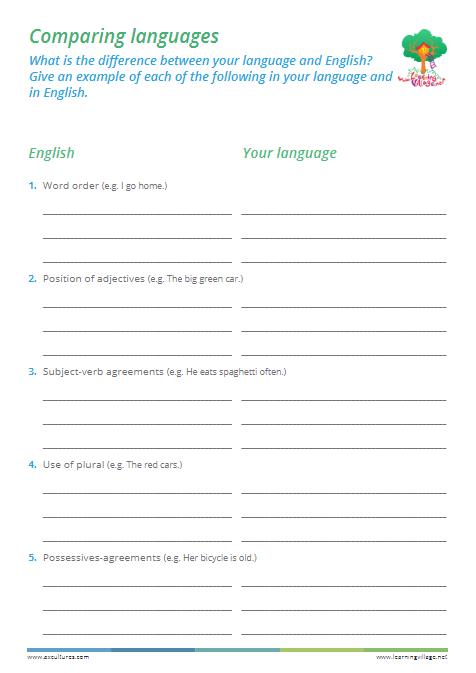

A lovely resource which encourages your learners to explore an interesting image and create and discuss their own.


Blended vocabulary, language structure and reading programme for EAL and multilingual learners
Once you have registered for your free trial we will be in touch to get you started on the first step of your Learning Village Journey.