We Care About Your Privacy
By clicking “Accept all”, you agree to the storing of cookies on your device to enhance site navigation, analyze site usage, and assist in our marketing efforts. View our Privacy Policy.
Stories are a powerful way for children to develop language skills and connect with their culture. Specifically, for EAL families, storytelling in their home language is a way to preserve cultural traditions and is an essential part of their children’s multilingual development.
Sharing culture-specific stories also helps children to develop a deeper understanding of their cultural values and shape their own unique perspective of the world around them. This shared storytelling is intrinsic to strengthening learners’ family bonds and creating a strong sense of belonging, whilst also enjoying valuable reading time with their parents.
Children who have a solid foundation in their home language are more likely to succeed in learning additional languages and often find it easier to learn English. By sharing or reading stories in their first language, parents help to provide their children with this strong linguistic background, which will then support their English language development. By listening to or being encouraged to read stories in their home language, children enrich their vocabulary and improve their comprehension and critical thinking skills.
Parents can also utilise bilingual books, which allow children to compare both languages. Apart from helping children gain confidence in their abilities as bilingual speakers, the practice of establishing reading routines also nurtures an overall love of reading, which has been well documented as being crucial for future academic success.
Parents can enhance the reading experience by using an expressive voice whilst reading, asking questions, or encouraging children to retell a story or share their views. For more tips and ideas on how parents can make the reading routine more fun for their children, download our useful resource in the buttons above and below the article.
Schools, on their part, can encourage children to share stories from their culture in class or compare similar versions of tales across cultures. This helps to celebrate diverse languages and create an inclusive environment where every child feels welcome and valued.
Encouraging EAL parents to embrace reading in their home language clearly has a multitude of lifelong benefits for multilingual children’s overall development and progress. Reading a story is not only an enjoyable family activity but also a powerful process of creating emotions, building bonds, and passing a family’s language and heritage down to the next generation.
References
Dickinson, D. K., Griffith, J. A., Michnick Golinkoff, R., & Hirsh-Pasek, K. (2012). How reading books fosters language development around the world. Child Development Research, 2012.
Kerry-Moran, K., & Aerila, J. (2019). Introduction: The strength of stories. In K. Kerry-Moran, & J. Aerila (Eds.), Story in children’s lives contributions of the narrative mode to early childhood development, literacy, and learning (pp. 1-8). Switzerland: Springer.
The Bell Foundation, (2020). Working with parents to support the learning of pupils who use EAL: Guidance for schools. Available online.
Immersion in the new language and regular practice are fundamental aspects of fluency development in second language acquisition and instruction. However, there is much discussion on the benefits of using learners’ first language (L1) in language lessons (Cummings, 2007). This article explores some of the main benefits of incorporating students’ L1 in ESOL instruction as well as some practical ideas for activities that could be used for this purpose.
AI technology can offer adult learners of English or multilingual families a supportive, fun and engaging environment in which to learn and practise their English. Schools can play an instrumental role in guiding those families through this process and therefore home-school collaboration is always encouraged. Let’s look at four different ideas for school staff to encourage their multilingual families to engage in an enjoyable language learning experience through AI.
Language is a key part of one’s identity and our level of fluency in a language can truly affect the way we view ourselves (Patterson, 2021). It is often incredibly difficult for monolingual individuals, who are highly proficient in their language, to imagine the extent to which language ability in any language, be it a home language or an additional language, is linked to one’s self confidence and perception of themselves. What happens when your level of language proficiency becomes a barrier to communication, learning, and the world around you?


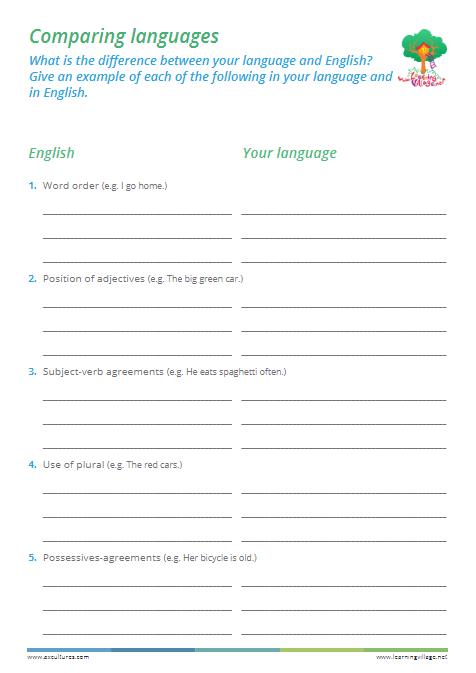

A lovely resource which encourages your learners to explore an interesting image and create and discuss their own.


Blended vocabulary, language structure and reading programme for EAL and multilingual learners
Once you have registered for your free trial we will be in touch to get you started on the first step of your Learning Village Journey.